Willow thought the worst part of the night was the PCPD. It was not. The July 27 episode placed the real danger inside her own home, waiting in the form of a wet, muddy trail that stopped her frantic packing cold. The canon sequence is straightforward: Willow returned from questioning connected to Sidwell, hurriedly began preparing to leave, noticed the marks on the floor, and then came face-to-face with a soaked Drew Cain. Gio had found Drew alive in the lake. That is what aired. What the episode did not confirm is equally important: it did not say Drew planted the footprints, faked paralysis, or had already mapped out a revenge scheme. [1]
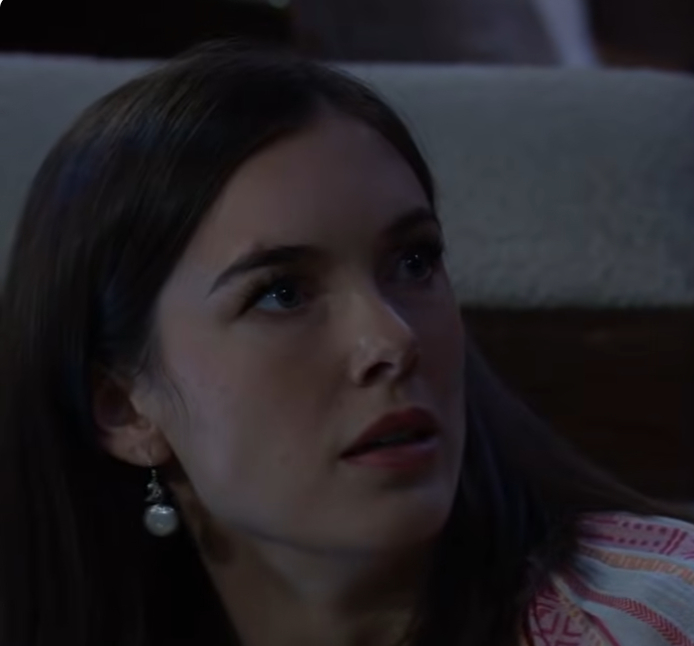
But the scene was staged like a threat, not like a simple rescue aftermath. First came the silent evidence of someone crossing Willow’s private space. Then came the door slamming shut. Finally, Drew appeared upright in front of a woman who had every reason to believe his survival would destroy the fragile story she had been trying to preserve. The show did not need Drew to make a speech. Willow’s freeze, her breathless urgency, and the dreadful timing did the work for him. The footprints became a visual alarm bell: the past had followed her home.
That is where the fanwish angle becomes so potent. Willow has been trying to outrun consequences for decisions connected to Drew’s ordeal, while Drew has spent the story framed as vulnerable, injured, and unable to fight back. The episode flips that power arrangement in one image. A man Willow expected to be powerless is suddenly standing in her doorway. A woman who believed she still had choices is staring at the proof that escape might already be impossible. The theory is not that Drew has a canon-confirmed master plan. It is that the writers have finally handed him the most satisfying possible weapon: time to let Willow’s fear do the damage.
A revenge story works best when the target cannot tell which part of the punishment is real and which part is imagined. That is why the wet trail matters more than a threat would have. If Drew had burst in shouting, Willow could focus on defending herself. Instead, the marks gave her several agonizing seconds to wonder whether someone was inside, whether she was already being watched, and whether every move she made would be used against her. The object clue does not prove intent, but it produces the exact emotional effect a trap would produce. Willow is no longer reacting to facts alone. She is reacting to what Drew could know.
Drew does not even have to decide whether he wants police justice, personal revenge, or something far more strategic. The potential leverage is already enormous. Willow’s first instinct was to pack and flee. Her instinctive panic may be more revealing than any speech she could make later. The longer she tries to protect herself, the more likely she is to make a mistake, trust the wrong person, or let her guilt guide her toward choices that expose the people around her. In a story built around secrecy, a terrified cover-up can become more dangerous than the original act.
There is also a deeply satisfying reversal in letting Willow suffer uncertainty rather than handing her a neat consequence immediately. Drew spent time dependent on other people’s explanations, his mobility, and the assumptions they made about him. Now Willow is the one who cannot read the room. Every knock at the door, every police question, every ally who suddenly sounds less loyal can become another turn of the screw. That is not a spoiler. It is the most emotionally logical direction the episode’s staging invites viewers to imagine.
The July 27 ending therefore does not prove that Drew is a villainous mastermind or that he orchestrated every detail. It proves something more valuable for a revenge fantasy: Willow finally understands that Drew is not gone, not helpless, and not outside her life. He is back inside the one place she thought she controlled. The muddy footprints may wash off the floor, but the message will not. If Drew wants the ultimate payback, he does not need to chase Willow. He only needs to stand still and let her realize that the reckoning has already crossed the threshold.
