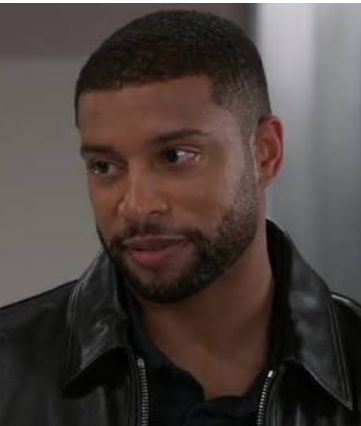
Martin’s latest flashback may have revealed something far more disturbing than simple guilt. It took only one word—”tornado”—to send him spiraling back to the night Kenny died. No one mentioned Kenny. No one brought up the cover-up. No forgotten evidence suddenly appeared on screen. Yet Martin reacted as if the past had come crashing through the door without warning. That moment raises an unsettling possibility. What if the real danger isn’t the memory of Kenny’s death at all? What if Martin fears that someone—or something—connected to that night has never truly disappeared?
The most important detail in the scene is what did not happen. The episode did not introduce a new suspect, uncover hidden evidence, or reveal a long-lost witness. Instead, the trigger came from an ordinary conversation containing a single reference to a tornado. That reaction resembles unresolved trauma far more than an ordinary guilty conscience. Trauma often resurfaces when the mind encounters a seemingly unrelated reminder that reconnects it to an unbearable memory. The word itself may not matter. What matters is how instantly Martin’s mind returned to the Kenny incident, suggesting that the psychological wound remains as raw as ever.
That distinction changes the entire conversation surrounding the storyline. It would be easy to assume Martin is simply haunted by what happened years ago. However, the intensity of his response may point toward something even deeper. His panic resembles someone who believes the past is no longer safely buried. The flashback feels less like remembering an old tragedy and more like anticipating that an old secret could suddenly become dangerous again. The show never says this outright, but the emotional weight of the scene leaves room for that interpretation.
The Kenny cover-up has always been presented as a successful operation, but success and perfection are not the same thing. Canon establishes that the immediate consequences were contained. The truth remained hidden, and legal fallout was avoided. What has never been established is something much more significant. The series has never confirmed that every possible witness was identified. It has never stated that every camera angle was checked. It has never explained whether someone else passed through the area that night or whether every piece of physical evidence was accounted for. Those questions remain surprisingly unanswered.
That historical gap may be one of the biggest unresolved weaknesses in the entire storyline. The audience knows Kenny died. The audience knows a cover-up followed. But countless practical questions have never received definitive answers. Who saw Kenny before his death? Did anyone notice where he was going? Were there nearby homes, businesses, or traffic cameras? Did another vehicle pass through the area? Could someone have overheard an argument without understanding what was actually happening? None of these possibilities have been ruled out. The absence of answers is precisely what keeps the mystery alive.
Perhaps the most chilling possibility is that the greatest threat is not an intentional witness at all. Imagine someone who unknowingly preserved a forgotten piece of history. An old security recording stored in an archive. A family photograph that accidentally captured part of the background. A voicemail never deleted. A damaged phone recovered years later. A forgotten hard drive sitting untouched in a storage box. None of these scenarios require the series to rewrite established canon. More importantly, none of them have been excluded by anything currently shown on screen. This is not evidence that such an item exists. It simply highlights that the story has never proven one could not.
Martin’s continuing nightmares strengthen this interpretation. His recurring panic attacks and flashbacks suggest a man who has never believed the crisis was completely over. If every loose end had truly been eliminated, why does the fear continue to dominate him years later? Trauma alone can certainly explain recurring nightmares. Yet the timing of this latest flashback invites another possibility. Martin may not simply fear remembering Kenny. He may fear that something outside his control could force everyone else to remember as well.
Seen through that lens, the tornado reference becomes far more symbolic than literal. Storms represent chaos, unpredictability, and the destruction of carefully constructed order. Martin’s carefully maintained version of the past depends on stability. A single emotional trigger is enough to shatter that stability, suggesting that his greatest fear is not the memory itself but the possibility that circumstances beyond his control could reopen everything he believed was sealed forever. The tornado comment functions less as evidence and more as a warning signal inside Martin’s own mind.
If Beyond the Gates ever decides to revisit the Kenny storyline, it may not need to introduce a brand-new villain or an unexpected confession. The most powerful twist could emerge from something much smaller—a forgotten detail that everyone assumed no longer mattered. One overlooked witness. One unnoticed recording. One ordinary object carrying extraordinary significance. Such a revelation would not contradict established history. Instead, it would expose the one assumption the cover-up was never able to prove: that absolutely no one else knew what happened that night.
At this point, the series has not confirmed that another witness exists, nor has it revealed any forgotten physical evidence connected to Kenny’s death. That remains entirely speculative. What the show has established is Martin’s severe trauma, the existence of the original cover-up, and a history that still contains unanswered questions. Those unanswered questions may ultimately become more dangerous than any secret already exposed. Because sometimes the most devastating mystery is not what people chose to hide—it is what they never realized had been left behind.
