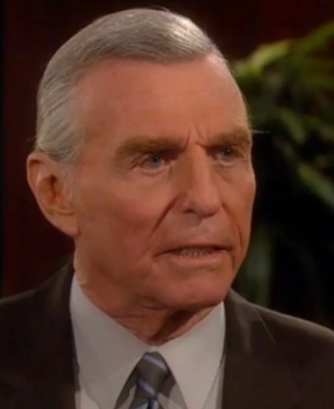
Billy Abbott may have just exposed the biggest weakness in Chancellor’s ownership history — but what if the information he revealed is only the part he wants everyone to see? The current storyline has already established that John Abbott once rescued Chancellor with a massive financial arrangement. The agreement reportedly gave the Chancellor side 20 years to repay the money, with the consequence that the Abbott family could claim ownership if the debt remained unpaid. On the surface, that sounds like a straightforward creditor agreement. But Billy’s behavior suggests there could be much more hiding underneath it.
The most suspicious detail is not even the 20-year provision. It is the confidence with which Billy is approaching the entire situation. Billy does not appear to be acting like someone who has simply discovered an old unpaid debt. He is behaving like someone who believes he has uncovered a legitimate path to control Chancellor. That distinction matters. If Billy only had evidence of an ancient loan, he would still face enormous questions about repayment, ownership transfers, probate, documentation and the passage of decades. Yet his attitude suggests he believes the Abbott position is far stronger than a simple creditor claim.
That raises the central question: Did Billy reveal the entire contract, or only the portion that gives him immediate leverage? A document this old could contain more than one important provision. The 20-year repayment clause may be the most dramatic part of the agreement, but it does not necessarily explain why Billy appears so certain about the Abbott family’s position today. There could have been additional language concerning ownership, collateral, voting rights, control of assets or other conditions attached to John’s original bailout.
A hidden ownership provision would completely change the meaning of the story. Instead of John Abbott simply lending money to Chancellor, John may have negotiated a form of silent ownership as part of the rescue. That could mean the Abbott family was never merely waiting for repayment. They may have been given an economic or controlling interest that could become enforceable under specific circumstances. If Billy has discovered such language, then the 20-year provision may actually be only one piece of a much larger arrangement.
Another possibility is that John secured control rights rather than direct ownership. A powerful businessman providing a huge bailout could have demanded collateral or special rights in exchange for taking such a significant financial risk. Those rights could potentially involve the company’s assets, leadership decisions, voting power or future ownership transfers. If something like that exists, Billy would have far more ammunition than an unpaid loan. He could argue that John Abbott was protecting the family’s position from the beginning, even if the arrangement was never publicly treated as an ownership deal.
There is also a major historical problem that Billy must overcome. The agreement is reportedly around five decades old, meaning the Chancellor business has passed through multiple ownership changes, deaths, estates and probate proceedings. That creates an obvious legal and narrative weakness. An old contract does not automatically prove that a current company belongs to someone else. Billy needs more than the existence of the document. He needs a clear chain showing that the obligation survived every relevant transfer and that the Abbott family’s rights were never legally extinguished.
That is precisely why a second clause would be such a powerful twist. If Billy can produce language showing that John’s rights survived changes in ownership, then the entire Chancellor dispute could suddenly look different. The question would no longer be simply whether an old debt was repaid. It would become whether Chancellor’s ownership structure was ever fully transferred away from the Abbotts in the first place.
The timing could also explain why Billy might not immediately reveal everything. If he has another piece of evidence, withholding it could give him strategic leverage. Lily and Cane may believe they understand the threat and prepare their defense around the 20-year repayment provision. Then Billy could produce another section of the agreement that they never anticipated. In classic soap fashion, the first revelation would not be the final bombshell — it would be the setup for an even bigger one.
The most explosive possibility is that John Abbott was not simply Chancellor’s creditor. He may have been a silent owner whose rights were buried inside the original bailout agreement. If Billy can prove that, the Chancellor battle could escalate from a dispute over historical debt into a direct fight over who has the legitimate right to control the company.
For now, the 20-year provision remains the established foundation of the story, while the hidden-clause theory remains speculation. But Billy’s unusually confident behavior creates the perfect opening for another revelation. He may have shown everyone the contract — without showing them everything that is inside it. And if the missing section contains an ownership or control provision, Lily and Cane could discover far too late that Billy was never fighting for a debt. He was fighting for Chancellor itself.
