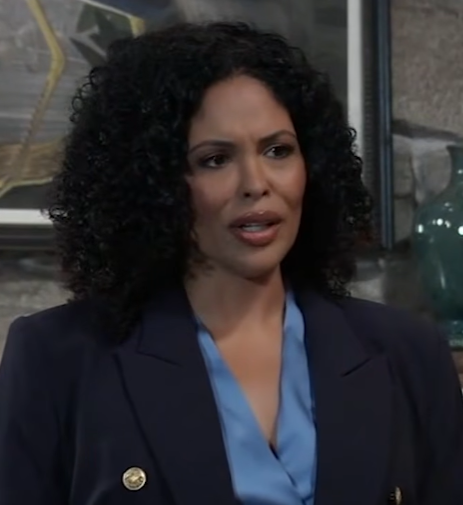
Monet Mitchell may have just walked into the most explosive custody case in Port Charles. Chase hired her to protect his place in Phoebe’s life, but the new attorney could uncover something far more dangerous than Tracy Quartermaine’s latest scheme. Buried inside the little girl’s adoption paperwork may be the first real clue to her biological father’s identity—and it could expose the lie Ethan Lovett worked so hard to keep hidden.
The key is not a mysterious stranger suddenly arriving to claim Phoebe. It is a DNA test that never should have been trusted.
Ethan presented himself as Phoebe’s father and agreed to surrender his parental rights, helping clear the way for Chase and Brook Lynn to adopt Delilah’s daughter. But Ethan’s claim was never as straightforward as it appeared. He secretly replaced the DNA sample taken from him with material obtained from PCPD evidence storage. He later admitted to Ava that he was not Phoebe’s biological father and had assumed that role to honor a promise to Delilah.
That deception creates a question no one in the custody battle can afford to ignore: Whose DNA did Ethan actually submit?
Monet has a legitimate reason to ask. With Chase fighting to remain in Phoebe’s life, his attorney would need to examine the documents establishing the adoption, the surrender of parental rights, and the evidence supporting Ethan’s original claim. A lawyer looking for weaknesses in Tracy’s position could instead discover a weakness in the paperwork everyone has accepted.
Imagine Monet requesting the original laboratory records rather than relying on the final report. One small discrepancy catches her attention: the sample identification number does not match the collection record from the hospital. The date, source, or evidence reference points somewhere entirely different.
That is where Ethan’s carefully constructed story begins to collapse.
Monet could trace the number to an old PCPD evidence file and discover that the material Ethan substituted was connected to a man whose name has never appeared in Phoebe’s adoption documents. The discovery would not automatically prove that man is her father. But it would establish that Ethan deliberately introduced another person’s DNA into the process—and give Monet a concrete name to investigate.
For Chase, the implications would be terrifying. He hired Monet to strengthen his claim as Phoebe’s father. Instead, she could uncover evidence that the family’s understanding of Phoebe’s biological origins was built around a deliberate substitution.
Brook Lynn would face an equally painful possibility. She has already endured the loss of Delilah and the strain of fighting Chase over their daughter. Learning that Ethan’s farewell letter and parental surrender concealed another man’s identity would force her to question how much of Delilah’s final wish anyone truly understood.
And Ethan’s motive could be the most revealing part of the mystery.
If he only wanted to help arrange Phoebe’s adoption, why risk tampering with DNA evidence? Why not simply tell Alexis that Delilah had asked him to protect her child? His willingness to create a false biological connection suggests that keeping the real father out of the picture mattered more than protecting himself from legal consequences.
That brings Hudson Parker into sharper focus.
Hudson pursued Ethan overseas and was told that Delilah and her baby were dead. He later appeared in Port Charles and moved closer to the people caring for Phoebe. Those actions have encouraged suspicions that Hudson himself might be the missing father. But Monet’s discovery could turn that assumption upside down.
What if Hudson was never searching for his own daughter?
What if he was searching for Phoebe on behalf of the man Ethan had tried to erase?
A second clue could be waiting in the letter Alexis gave Chase and Brook Lynn. Monet might notice a reference to a place, a date, or a promise that means little until she compares it with the old police evidence file. Suddenly, Ethan’s words would read less like a father saying goodbye and more like a warning from someone determined to keep Delilah’s child beyond another man’s reach.
The real shock would come when Monet connects that hidden name to someone already operating in Port Charles.
A powerful man with a reason to conceal his connection to Delilah would not need to arrive at the Quartermaine mansion and announce himself. He could let Ethan take responsibility, send someone else to locate Phoebe, and wait until the custody battle creates an opening.
Monet may be the first person positioned to recognize that possibility.
Tracy believes the fight is about whether Chase or Brook Lynn should raise Phoebe. Chase believes his attorney is protecting the family he refuses to lose. Brook Lynn believes the greatest threat is the man she once trusted.
But if Monet follows Ethan’s fake DNA test back to its source, all three could discover that Phoebe’s biological father has been part of this story much longer than anyone realized.
And the name Ethan tried to bury could be the one that finally tears the custody battle apart.
