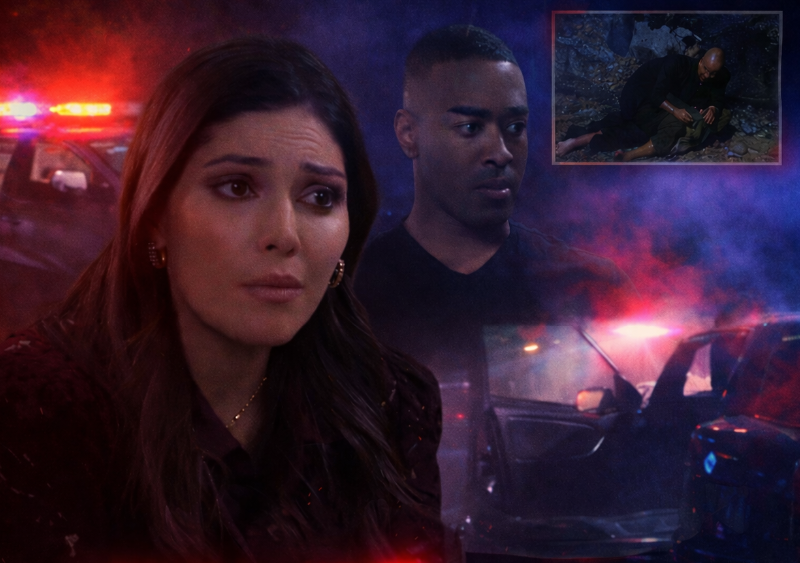
What initially looked like a tragic accident involving Curtis and Jordan is quickly unraveling into something far more complex and potentially deliberate. The biggest clue is not what we saw—but what we didn’t. The scene was framed like a sudden impact, but fan analysis points to missing pieces: no clear visual of the second vehicle, no confirmation of direct contact, and inconsistent reactions from multiple characters afterward. This wasn’t just chaos—it was structured confusion, and that alone suggests intention rather than coincidence.
Isaiah has become one of the most controversial suspects, not because of hard evidence, but because of behavior. His reaction to the news of the crash felt off—hesitant, conflicted, almost like someone processing guilt instead of shock. The fact that he chose not to immediately go to the hospital, despite being a doctor, raised even more red flags. In a show where reactions often reveal more than actions, Isaiah’s restraint may be the loudest clue yet. It doesn’t prove he caused the crash, but it strongly suggests he knows more than he’s willing to say.
At the same time, Brook Lynn’s involvement cannot be ignored. The visual emphasis on the wine bottle was not subtle—it was intentional. In soap storytelling, objects don’t get highlighted without purpose. Her rushed exit, her disoriented state, and her uneasy reactions when the crash was mentioned all point to internal panic. Whether she directly caused the accident or simply fled the scene after witnessing it, her behavior aligns too closely with guilt to dismiss. The real question is not just what she did—but what she’s afraid will be discovered.
Then there is the possibility that no one “hit” anyone at all. A growing theory suggests that Jordan may have caused the crash herself through a moment of distraction. The detail that she may have drifted out of her lane, combined with a sudden overcorrection, creates a realistic chain of events that doesn’t require a direct collision. But even this explanation doesn’t fully settle the mystery. If it was truly self-inflicted, why is the narrative working so hard to introduce multiple suspicious figures around the same moment?
The answer may lie in the idea that this wasn’t a single incident, but a chain reaction. Several fans believe there were multiple vehicles involved indirectly—someone swerved, someone else reacted, and the crash became inevitable. This opens the door to a far more layered truth: more than one person may be responsible, even if none of them intended to cause harm. In that scenario, the real drama shifts from “who did it” to “who will be blamed first.”
Another critical detail is the classic soap tactic of misdirection. By placing suspicion on multiple characters at once—Isaiah, Brook Lynn, even Jordan herself—the story creates noise that hides the real signal. The wine bottle could be a red herring. Isaiah’s behavior could be tied to an unrelated secret. Jordan’s distraction could be exaggerated to divert attention. When every clue points somewhere different, it often means the truth is somewhere no one is currently looking.
What makes this storyline compelling is not just the mystery, but the emotional fallout it promises. If Isaiah is involved, it could destroy his credibility and relationships instantly. If Brook Lynn is exposed, it could trigger consequences that extend far beyond this single event. And if Jordan truly caused it herself, the guilt alone could become a long-term arc. No matter which direction the truth goes, the impact will not be contained to one character—it will ripple through multiple storylines at once.
In the end, this crash feels less like an accident and more like the beginning of a carefully constructed unraveling. Too many people are acting strangely. Too many details were highlighted. Too many questions remain unanswered. And in a world like Port Charles, that usually means one thing: the truth is already in play—it’s just being hidden in plain sight until the perfect moment to explode.