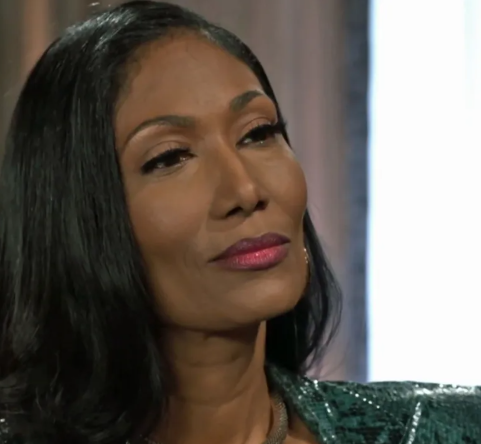
While most viewers were focused on the tornado chaos, the missing victims, and the desperate search for Eva, Beyond the Gates may have quietly delivered one of its most important clues yet. It didn’t come from a dramatic confrontation. It wasn’t hidden in a DNA test or a secret file. Instead, it came from a single sentence spoken by Leslie at a moment when her guard appeared to slip.
During the June 11 episode, Leslie helped Anita by tending to her injury and remarked that she was used to doing this for Eva. Then, seemingly out of nowhere, she said something that immediately stood out: “I’m being punished.” Anita quickly pushed back, insisting that tornadoes and God do not work that way. The conversation moved on, but the line itself lingered. In a show where dialogue is often carefully chosen, those three words may carry far more weight than they initially appeared to.
What makes the statement so striking is that nobody accused Leslie of anything. Nobody suggested she deserved what was happening. Nobody blamed her for Eva’s disappearance or the danger surrounding the storm. Yet Leslie instantly framed the situation as a punishment. That choice of words raises an uncomfortable question: punished for what?
For years, Leslie has been portrayed as someone who rarely accepts responsibility for her actions. She has blamed other people for her struggles, justified her schemes, and consistently viewed herself as a victim of circumstances. That has been one of her defining character traits. Because of that history, hearing her suddenly describe herself as someone being punished feels incredibly unusual. This wasn’t a woman expressing fear. It sounded like a woman expressing guilt.
There is an important difference between saying “I’m terrified” and saying “I’m being punished.” Fear is about the present. Punishment implies the past. It suggests that a person believes they have done something wrong and are now facing consequences. Whether Leslie consciously meant it or not, her wording connected Eva’s disappearance to a burden she may have been carrying for a very long time.
Even Anita’s response makes the scene more interesting. Notice what she did not say. Anita did not tell Leslie that she had done nothing wrong. She did not reassure her that she had no reason to feel guilty. Instead, Anita challenged the idea that a tornado was some form of divine retribution. In other words, Anita rejected the concept of punishment from God, but she never addressed the possibility that Leslie was struggling with guilt. That subtle distinction may be extremely important.
The timing of the line is equally fascinating. Leslie utters it while worrying about Eva, the person at the center of one of the show’s longest-running mysteries. Questions surrounding Eva’s true origins have circulated for a long time, and many unresolved pieces of her story continue to attract attention. Why has Leslie always been so controlling of Eva? Why has she repeatedly involved Eva in her personal agendas? Why does their relationship sometimes feel more strategic than maternal? Those questions have never completely disappeared.
That is why the June 11 dialogue has sparked renewed attention around a theory that has existed for quite some time. According to this theory, Leslie knows far more about Eva’s origins than anyone realizes. Some versions go even further, suggesting that Eva may not be Leslie’s biological daughter at all. Other variations propose that Nicole is somehow connected to the truth and that Eva’s real identity has been hidden for years. None of these theories have been confirmed on-screen, but they continue to survive because several details surrounding Eva’s past remain unexplained.
Viewed through that lens, Leslie’s statement becomes much more than a reaction to a natural disaster. Imagine for a moment that she has been protecting a major secret for years. Imagine that every decision she made involving Eva was built upon that secret. Now imagine watching Eva disappear into a life-threatening crisis. Under those circumstances, “I’m being punished” would sound less like panic and more like a subconscious confession.
Soap operas have a long history of planting clues months before revealing the truth. Sometimes the biggest hints are not hidden in evidence, but in emotion. Characters often reveal themselves when they are frightened, exhausted, or vulnerable. Leslie was all three during the June 11 episode. If the writers intended this line to mean something deeper, it could eventually be remembered as one of the earliest signs that a major revelation was already approaching.
Of course, there is currently no canon evidence proving that Eva is not Leslie’s daughter or confirming any specific theory about her origins. The June 11 scene does not provide definitive answers. What it does provide is a question that refuses to go away. Why would Leslie look at Eva’s disappearance and immediately interpret it as punishment?
That question may ultimately matter more than the answer itself. Because in that brief moment, Leslie revealed something she almost never shows: a guilty conscience. And if she truly believes she deserves punishment, then the real secret may not be what happened during the tornado. The real secret may be what happened years ago—and whether Eva has been living inside that secret her entire life.
