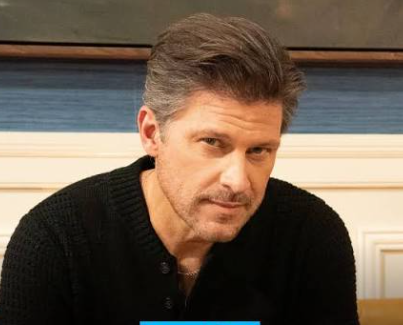
For months, one question has quietly lingered beneath every tense scene between Kial and Noah: why does Kial seem emotionally detached from his own son? Their relationship has never carried the warmth expected between a grieving father and the child he supposedly raised. Instead, every conversation feels strained, every disagreement feels deeper than ordinary family conflict, and every decision Kial makes pushes Noah further away. What if that emotional distance has never been about disappointment? What if it began years ago, the moment Kial discovered a DNA secret that changed everything?
One detail stands out above all the others. When the tension between them reached its breaking point, Kial appeared more willing to leave the house than continue living with Noah. That reaction feels unusually extreme. Parents and children argue all the time in soap operas, yet they rarely choose complete separation without a much darker reason. It almost feels as though Kial has been carrying an emotional burden for years, one that has slowly eroded every chance of a genuine father-son relationship. If he already knew Noah was not his biological child, his coldness suddenly becomes much easier to understand.
Another clue appears in the way Kial refuses to financially support Noah. Rather than continuing to help him rebuild his life, Kial insists that Noah work at the Free Clinic and earn everything himself. On the surface, that could simply reflect Kial’s belief in discipline and responsibility. However, viewed through a different lens, the decision becomes far more interesting. Instead of acting like a protective father, Kial behaves like someone fulfilling a long-standing obligation. It raises a disturbing possibility: perhaps he agreed to raise Noah, but never truly accepted him as his own.
The most fascinating inconsistency, however, has existed since Noah first entered the story. Kial is a respected physician whose entire life revolves around order, structure, education, and discipline. Noah represents almost the complete opposite. He chose music instead of medicine. He follows emotion instead of logic. His personality is impulsive, artistic, and unpredictable. Of course, children often grow into adults who are very different from their parents, but soap operas have repeatedly used these dramatic personality contrasts as subtle hints that a hidden family secret is waiting to be exposed. The enormous gap between Kial and Noah feels less like coincidence and more like carefully planted groundwork.
Then there is Sarah. Despite being central to Noah’s past, she remains one of the least explored characters connected to this storyline. Very little is known about her marriage, her personal history, or the circumstances surrounding Noah’s birth. That absence of information creates the perfect opening for a future revelation. If Sarah hid the identity of Noah’s biological father before her death, almost every unanswered question surrounding this family would suddenly have a logical explanation. The mystery surrounding Sarah may be more important than anything already shown on screen.
This leads directly to the most explosive theory of all. Imagine that years ago Kial quietly learned the truth through a DNA test. He discovered Noah was never biologically his. Under normal circumstances, such a revelation could have destroyed the marriage and ended the relationship immediately. But what if something prevented him from walking away? What if another secret was even more dangerous than the DNA result itself?
That possibility introduces the darkest part of the theory: blackmail. Rather than freely choosing to raise Noah, Kial may have been forced into silence by someone who knew the entire truth. The leverage could have involved Sarah, another powerful family, or a scandal capable of destroying multiple lives. Instead of exposing the deception, Kial accepted an impossible compromise. He would continue raising Noah, protect the secret, and never reveal what he knew. Such an agreement would explain why Kial remained physically present while becoming emotionally absent. He stayed because he had no choice, not because he genuinely embraced the role of father.
Seen from this perspective, years of emotional distance suddenly form a completely different picture. Every harsh criticism, every awkward conversation, every refusal to become emotionally vulnerable may not have been driven by anger at Noah personally. Instead, they could reflect decades of unresolved pain directed toward the secret itself. Noah unknowingly became a constant reminder of a betrayal Kial could neither forgive nor expose. The tragedy is that Noah may have spent his entire life believing he failed to earn his father’s love when the real problem existed long before he was old enough to understand it.
One additional detail makes this theory even more compelling. It has already been established that Kial has another son who has not yet appeared. If that second son eventually enters the story and immediately shares Kial’s personality, values, and medical ambitions, the contrast with Noah would become impossible to ignore. The show could use that comparison to slowly guide viewers toward a much larger DNA revelation without revealing the truth all at once.
If this theory proves correct, the biggest twist will not simply be that Noah has a different biological father. The real shock would be discovering that Kial has known the truth for years and has spent every moment since trapped inside a promise he never wanted to keep. Suddenly, every cold stare, every painful argument, and every emotional wall between them would no longer look like bad parenting. They would become evidence of a secret that has been hiding in plain sight from the very beginning. The day that DNA truth finally comes out could redefine not only Kial and Noah’s relationship, but one of the most emotional family stories the series has ever told.
