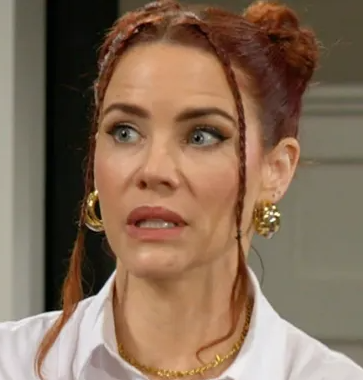
The latest episode of The Young and the Restless sparked thousands of online reactions, but surprisingly, very few centered on the actual storyline. Instead, one unexpected detail stole nearly every conversation: Sally Spectra’s brand-new hairstyle. With two high buns and braided strands framing her face, Sally’s fresh look instantly became one of the most discussed moments of the episode. The biggest surprise wasn’t that people noticed the hairstyle—it was how quickly the discussion shifted away from the plot and toward one question: Why would the production team make such a dramatic styling choice now?
What makes this reaction so fascinating is that it was never really about Courtney Hope. Across social media, countless viewers made the same distinction. They praised Hope’s beauty, complimented her confidence, and agreed she could pull off almost any look. The debate centered somewhere else entirely. Instead of criticizing the actress, many questioned the creative decision behind the hairstyle itself. That subtle but important difference transformed what could have been another conversation about appearance into a much broader discussion about production choices, visual storytelling, and character presentation.
This is exactly why many people believe the hairstyle wasn’t simply a random fashion experiment. In daytime television, almost every visual detail passes through multiple departments before reaching the screen. Hair, makeup, wardrobe, lighting, and continuity are carefully coordinated, especially on long-running soap operas where consistency matters from scene to scene. A completely different hairstyle doesn’t just appear by accident. It has to be planned, approved, filmed, and ultimately included in the final broadcast. That doesn’t automatically mean the hairstyle carries hidden story significance, but it does explain why so many people describe it as a deliberate production decision rather than an unfortunate styling mistake.
The intensity of the reaction also reveals something interesting about Sally as a character. For years, she has built a recognizable image built around confidence, sophistication, and bold fashion choices. Her appearance has always reflected someone who controls the room rather than someone trying to stand out. The new hairstyle completely disrupted that familiar image. Suddenly, Sally looked younger, more playful, and considerably less like the polished businesswoman viewers have come to associate with her. Whether people loved it or disliked it almost became secondary. The visual shift itself was enough to make everyone stop and pay attention.
That dramatic contrast has fueled several different theories. One possibility is that the creative team simply wanted to refresh Sally’s appearance. Long-running television series regularly update hairstyles and wardrobes to keep characters from feeling visually repetitive. If that’s the case, then the hairstyle may represent nothing more than a seasonal makeover designed to modernize Sally’s image while embracing current fashion trends inspired by Y2K and Gen Z aesthetics.
Another theory goes much deeper. Sally is entering one of the more emotionally complicated periods of her recent story. Between her evolving relationship with Billy and increasing professional pressure, her life has become far less predictable than it once was. Some viewers wonder whether the softer, more youthful hairstyle reflects that transition. Rather than presenting Sally as the composed executive she has been for years, the production team may be experimenting with a visual identity that suggests someone navigating uncertainty, reinvention, or emotional change. At this point, there is absolutely no confirmation from CBS or the production team supporting this interpretation, but it remains one of the more intriguing possibilities being discussed.
A third explanation focuses less on storytelling and more on television marketing itself. Sometimes a single unexpected creative decision generates more conversation than an entire episode’s worth of dialogue. Judging by the overwhelming attention this hairstyle received, that strategy certainly worked. The discussion spread rapidly because it created immediate curiosity. Instead of asking what Sally would do next, people began asking why she suddenly looked so different. Whether intentional or not, the hairstyle succeeded in making Sally the center of attention before anyone even started debating the episode’s biggest plot developments.
Perhaps the most remarkable aspect of this entire conversation is how respectful much of it has been toward Courtney Hope herself. Instead of attacking the actress, many comments have consistently separated performance from presentation. Courtney Hope continues to receive praise for her appearance, while the hairstyle itself remains the subject of scrutiny. That distinction elevates the discussion beyond simple criticism and turns it into something much more interesting: an examination of how styling decisions influence the way audiences perceive a character before that character even speaks.
Television has always relied on visual storytelling. Costumes, hairstyles, and makeup often communicate emotional shifts long before scripts explicitly explain them. At the same time, not every creative change carries hidden symbolic meaning. Sometimes a hairstyle is simply a hairstyle. As of now, CBS, The Young and the Restless, and the production team have offered no explanation for Sally’s new look, making every interpretation purely speculative.
Still, one undeniable fact remains. A few carefully arranged strands of hair managed to overshadow major story developments, dominate online discussion, and spark questions about the creative direction of one of the show’s most recognizable characters. Whether this was a bold fashion update, a calculated production decision, or the first visual hint of Sally’s next chapter, one thing is already clear: the hairstyle became the story—and perhaps that was exactly the point.
