The paint stain on the railing wasn’t just a typical forensic finding—it was the first crack in a story that suddenly seemed too perfect to be true. In Dante’s office, as “Nathan” updates on the paint sample, the scene unfolds like a routine investigation. But as soon as the lab confirms the paint matches a black German-made car, the story shifts from investigation to insinuation. The issue isn’t just about finding the driver anymore. It’s about who you suspect—and why.
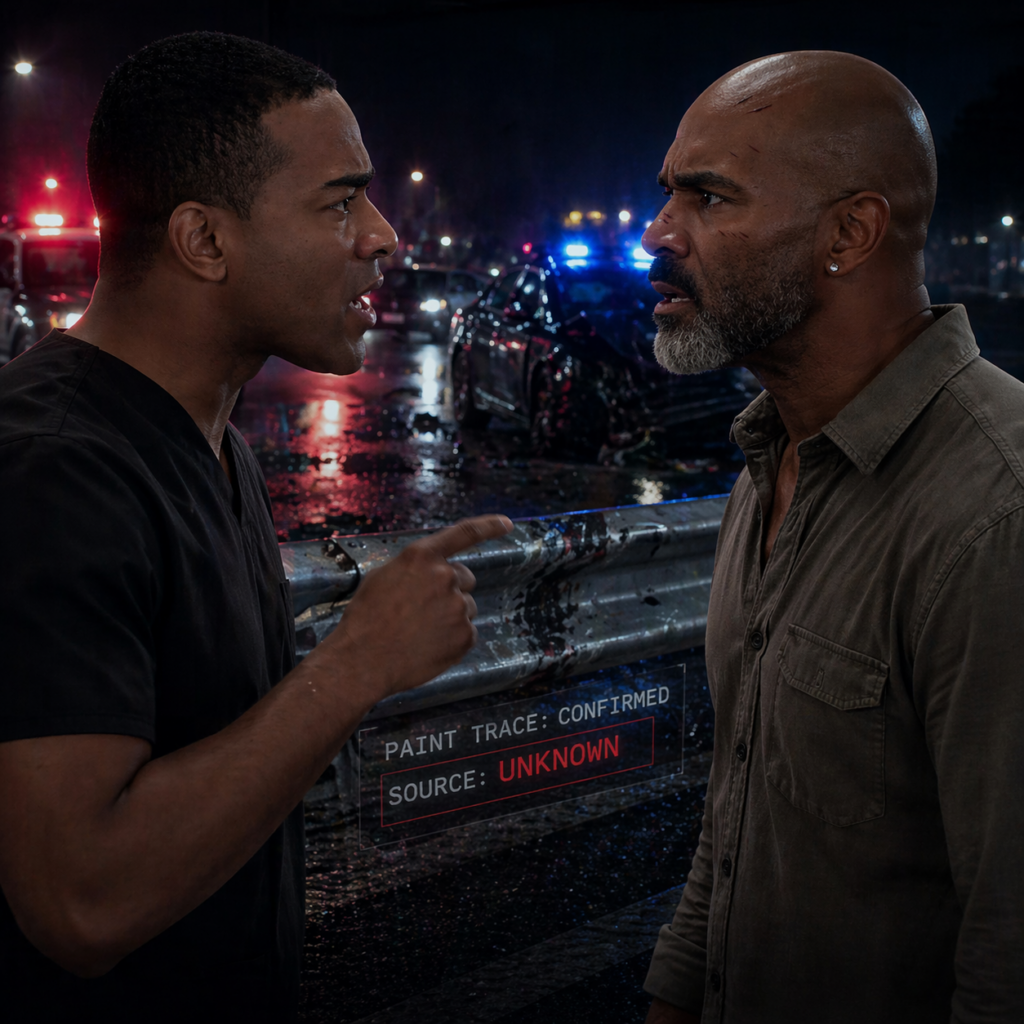
Dante’s urgency, fueled by pressure from Assistant Prosecutor Turner to apprehend the suspect, creates the perfect environment for a hasty conclusion. Online fan discussions have highlighted this detail, with many pointing out that the legal pressure seems excessive for a case still lacking direct witness evidence. That pressure is crucial because it narrows the scope of the investigation too quickly. Instead of asking “what really happened,” the investigation risks becoming “who fits the evidence fastest.” And right now, Isaiah fits the bill perfectly.
Curtis’s realization is shocking because it seems logical. A black SUV. Made in Germany. Isaiah drives that exact model, and on the day of the accident, Isaiah was driving to Lulu’s house to tend to Rocco’s wounds. It’s the kind of connection that should be satisfying—but instead, it feels contrived. On fan forums and discussion threads, viewers are questioning whether this clue was deliberately planted to lead both the characters and the audience to a false conclusion. The show has a history of using “obvious” evidence as a weapon, and this moment bears all the hallmarks of a diversion.
What makes this plot twist even more dangerous is the emotional repercussions involving Portia. If Isaiah is indeed her boyfriend, the implications aren’t just criminal—they’re deeply personal. Curtis isn’t just pursuing a clue; he’s facing the possibility that someone within Portia’s inner circle might be responsible for the near-fatal accident involving Jordan. That tension elevates the storyline beyond a simple mystery. It becomes a crack in trust waiting to explode.
But here’s where this theory becomes credible: multiple fan sources suggest the paintwork evidence might not be as obvious as it seems. Automotive experts in discussion groups have pointed out that “black SUV made in Germany” is an incredibly broad category. Without unique identifying marks—like a rare paint color variant or type of damage—the match could apply to dozens of vehicles. This raises a crucial question: Is the investigation being driven by incomplete data, or is someone deliberately providing just enough information to mislead?
Even more suspicious is the timing of the forensic examination call. “Nathan” received the update almost immediately after submitting the sample, which has led some fans to speculate about internal manipulation. Were the test results rushed? Or worse—altered? With theories circulating that “Nathan” might not be who he claims to be, this detail is causing alarm. If he is controlling the flow of information, then the entire case could be built on a foundation designed to collapse at precisely the right moment.
Another theory gaining traction is that the accident may not have been random. Some viewers believe Jordan and Curtis were the primary targets, and the hit-and-run driver was part of a larger scheme. If that’s true, then directing suspicion toward Isaiah could be a strategic move to divert attention from the real mastermind. In that context, the paint stain isn’t evidence—it’s a decoy.
What adds to the tension is Curtis’s reaction. He doesn’t confront Isaiah immediately. He thinks. That silence is crucial. It suggests doubt, hesitation, and perhaps the realization that the situation isn’t as simple as it seems. In narrative terms, it’s a warning sign. When a character suppresses emotion instead of action, it often means the truth is more complex—and more dangerous—than it appears.
This plot is rapidly evolving from a hit-and-run accident investigation into a multi-layered scam where every clue could be deliberately pointing in the wrong direction. The matching paint stain, the car description, the matching suspect—it all fits together too perfectly. And in a world like this, when everything fits together… that’s often the biggest clue that something is very, very wrong.